


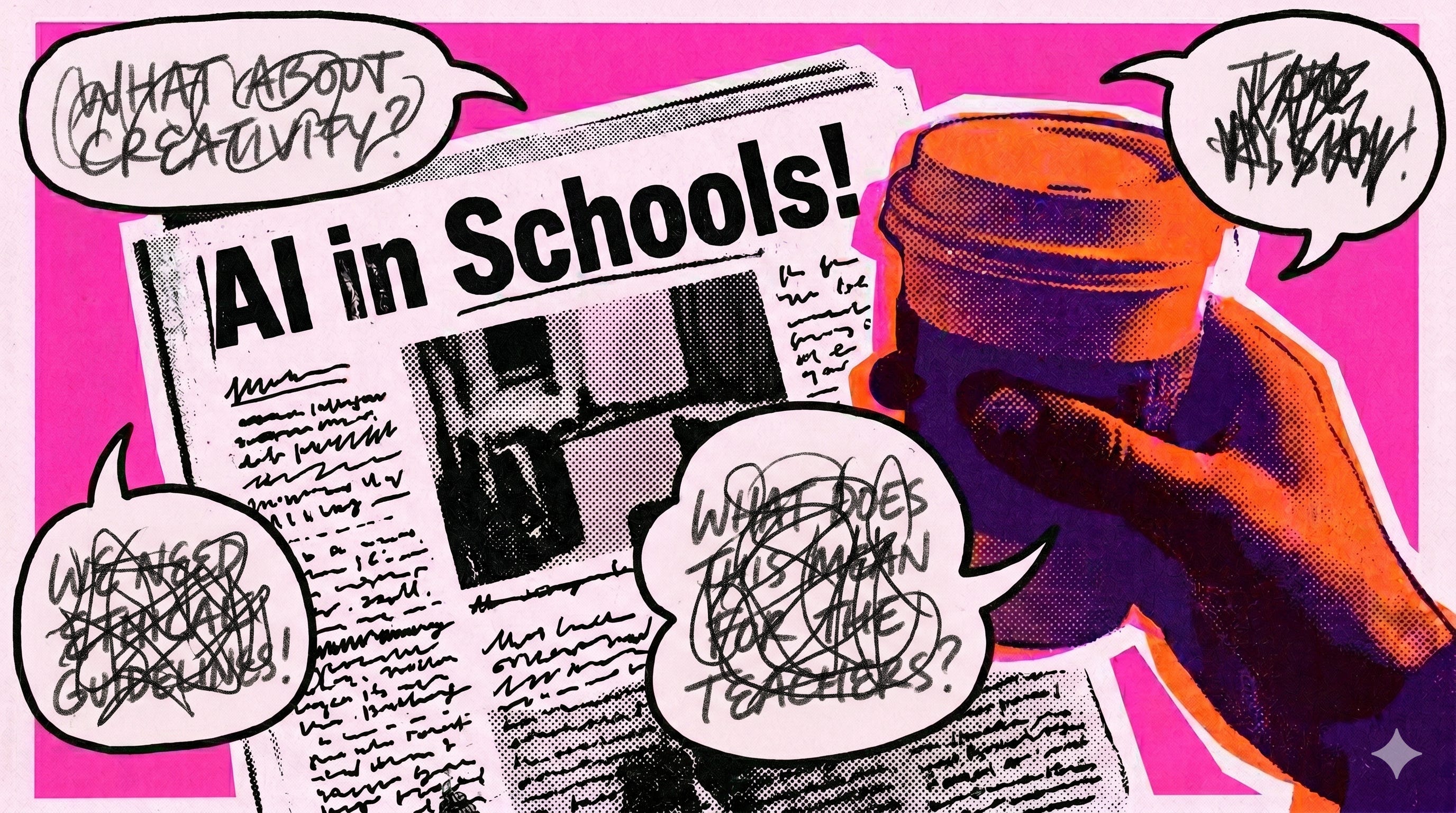
My wife and I had an argument (or what some participants would call a “conversation”) over coffee this morning.
Not the kind that ends badly. The kind that happens when two people with doctorates in education, who have spent their careers inside schools and school systems, read the same news and land in slightly different places. New York City Public Schools recently announced it was suspending plans to open a high school dedicated entirely to artificial intelligence. That was the news. The argument was about what it means.
We kept circling the same question: not whether a single AI-dedicated high school was a good idea—we both agreed it probably wasn’t—but what the city is actually going to do about the reality of AI in schools. Because suspending one high school is not a strategy.
Here is what I know from twenty years of watching technology enter schools: it almost never does what its advocates promise.
Thomas Edison believed educational film would revolutionize classrooms. It didn’t. The radio was supposed to transform learning. It didn’t. Television. The internet. Laptops. Bring Your Own Device movements. Each arrived with enormous promise and genuine enthusiasm from private sector partners, elected officials, and district leaders. Each time, the fundamental experience of school remained largely unchanged. Students still sit in rows. There’s still a teacher at the front of the room. The chalkboard became a whiteboard, and the whiteboard became a smart board. But the architecture of learning and teaching stayed the same.
I want to be careful here. AI is genuinely different in some important ways. The speed of its development, the breadth of its applications, the degree to which it can personalize interaction, these are real distinctions. I am not arguing that AI will have no effect on schools. I am arguing that the history of educational technology should make us deeply skeptical of any claim that it will overhaul them. That pattern of overpromising is not a coincidence. It is what happens when private sector interests, policy timelines, and genuine enthusiasm converge faster than pedagogy can keep up.
So what should the city actually do?
First, as I outlined previously, NYCPS needs to follow its initial AI guidelines with something substantive on pedagogy, and soon. The timeline they’ve set for themselves is ambitious. My strong suggestion: don’t treat this as an original composition. Treat it as a remix. There is already serious, rigorous thinking happening in other districts, states, nonprofits, and countries. Learn from it. Adapt it. The goal is good guidance for teachers, not authorship credit.
Second, and this is the idea I find most compelling, the city should consider a distributed AI labs model. We did something like this during the Bloomberg administration when we were exploring blended and online learning. Rather than designating one school as the AI school, identify AI lab sites across the system. For instance: one elementary, one middle, and one high school in every district across all five boroughs.
Each AI lab receives additional funding, which could be quickly raised in partnership with the city’s philanthropic partners. A meaningful portion of that goes toward buying time from a teacher who is already deep in this work, someone who has been genuinely experimenting with AI integration in their classroom. That teacher becomes the AI lab lead, working with a small cohort of colleagues to systematically explore what AI-informed teaching and learning can look like. They report back—both to central and at large convenings of lab leads across the city—building a shared knowledge base in real time.
For this to work, everyone has to do their homework. What is our theoretical framework? What have other cities and countries already learned? What are we strategically trying to find out, and what space are we leaving for genuine, unbridled experimentation? The answer to that last question, in my experience, should be: a little room for surprise, embedded inside a lot of intentional design.
This is not a new idea. It is a proven model applied to a new challenge. And it is infinitely more scalable, and more honest about what we know and don’t know, than concentrating all of our AI ambitions into a single school.
For nonprofits like the one I lead, there is a natural role here too. Organizations that specialize in teacher development, that have existing relationships with schools, that understand both the promise and the limits of ed-tech can plug into a model like this in ways that strengthen it. That requires reasonable funding and genuine strategic partnership. But the infrastructure and will exists.
The city doesn’t need an AI high school. It needs a thoughtful, distributed, teacher-led research effort that takes the history of educational technology seriously—and reimagines innovation not as the technology but as a problem-solving process that leverages the energy and creativity of communities.
That’s what my wife and I agreed on, somewhere around the second cup.