


By any reasonable measure, the Constitution of the United States is one of the most powerful written documents in human history. The original text clocks in at just 4,543 words. Add the twenty-seven amendments and the total climbs to 7,591. That so short a document provides the linguistic architecture for nothing less than democracy testifies to the ferocious power of writing.
It might surprise you to know, however, that the word education appears nowhere in the federal Constitution. Neither do schools, learning, or teaching. The Tenth Amendment sends anything not explicitly addressed (or forbidden) to the states. Education landed there not because the Founders wrote it out of the picture deliberately, but because they never wrote about it at all.
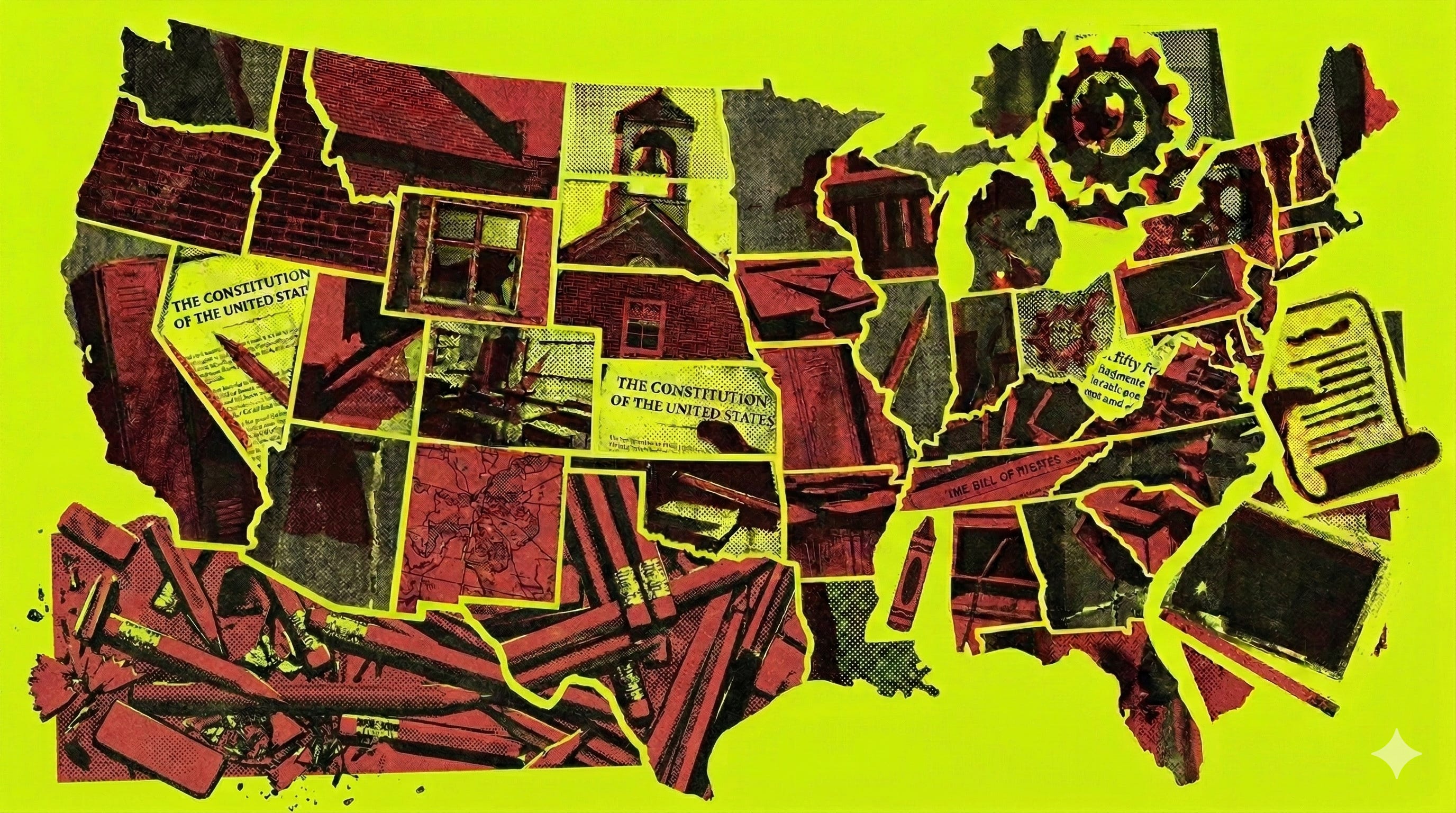
When I first stumbled on that omission, I felt genuinely stunned. No national articulation of education’s purpose in a democracy? That means fifty states could define it fifty different ways. And they do.
Fifty Systems, Not One
We speak casually about “the American education system” as though it were a single organism. It isn’t. It is fifty organisms, each with its own constitutional DNA, each under no obligation to coordinate with the others. Most industrialized nations maintain one centralized framework guiding what education means and how it operates. The United States has over four dozen. The phrase “American education” is, strictly speaking, a misnomer; what we have are American educations, plural, scattered across state lines like dialects of a language nobody bothered to unify.
Consider what this means in practice. One state’s constitution might enshrine education as a fundamental right, guaranteed to every child. Another might frame it as a legislative duty, subject to the whims of budget cycles and political fashion. A third might describe education in florid, aspirational language that sounds magnificent and commits to almost nothing. These are not minor semantic differences. Constitutional language shapes funding formulas, court decisions, curricular mandates, and the very question of who deserves access to a classroom. When fifty states answer that question independently, the result is not pluralism so much as fragmentation.
This is the quiet chaos hiding in plain sight. We argue endlessly about standardized testing, teacher pay, school choice, and curriculum wars, yet rarely pause to notice that the combatants are fighting on fifty different battlefields with fifty different rulebooks. There is no shared constitutional floor beneath public education in this country. The Founders, whatever their reasons, left that floor unbuilt.
Making the Invisible Visible
A question gnawed at me: what if I could help people compare those definitions side by side? What if I gathered the education clauses from all fifty state constitutions, linked each one to its original text, and plotted them on an interactive map that anyone could explore with a click? So that is exactly what I did, in a project I called “States of Education.”
Visit the map and you see a red pin in each state. Click one and a bubble opens, revealing the passage from that state’s constitution that first describes the purpose of or right to education, followed by a link to the primary source. The whole thing took about ten lines of code to build. That brevity still astonishes me; the barrier between a burning question and a public, interactive tool can be remarkably thin.
What struck me most during the building, though, was the reading. I sat with constitutional language from every state in the union, and the contrasts leapt off the spreadsheet. Some states treat education as sacred. Others treat it as a line item. The cumulative effect of reading them together is vertiginous: you begin to grasp just how profoundly uncoordinated the American approach to public schooling really is.
Why This Matters Now
The consequences of this constitutional silence grow louder by the decade. As families move across state lines, as national crises demand coherent educational responses, as technology reshapes what and how children learn, the absence of a shared federal commitment to education becomes less a quirk of history and more a structural vulnerability. We expect schools to sustain democracy, cultivate citizens, and equip young people for a bewilderingly complex world. Yet we have built no constitutional consensus about what that work even means.
My observations about the Constitution and education’s conspicuous absence from it might have remained confined to a column, a conversation with friends, a classroom lecture. Instead, I transformed a question and a spreadsheet into an interactive visualization that makes state constitutions infinitely more accessible to educators and communities. From such interaction, new questions might emerge. Perhaps even grassroots refinement of state legislation.
It seems fitting that a tool designed to illuminate what the Constitution left unwritten should itself be a small act of democratic participation: an invitation to read, to compare, to ask whether fifty separate answers to the most important question in public life is truly the best we can do.
This is a reworked version of a column called “The Computer’s Constitution” originally appearing in English Journal.