


The Greeks had a word for it. Tekne: craft, skill, the practiced hand that knows what it’s doing. Classicist Simon Goldhill notes that the word carried a second, darker life; it became, at a certain point, something of an insult. Sophists sold textbooks promising rhetorical mastery to anyone who could afford the fee. Tekne, in that degraded sense, was counterfeit knowledge: the appearance of wisdom without the labor of actually acquiring it.
I have been thinking about that ancient suspicion a great deal lately, because I have been writing with AI. After all: our word technology is etymologically rooted in tekne.
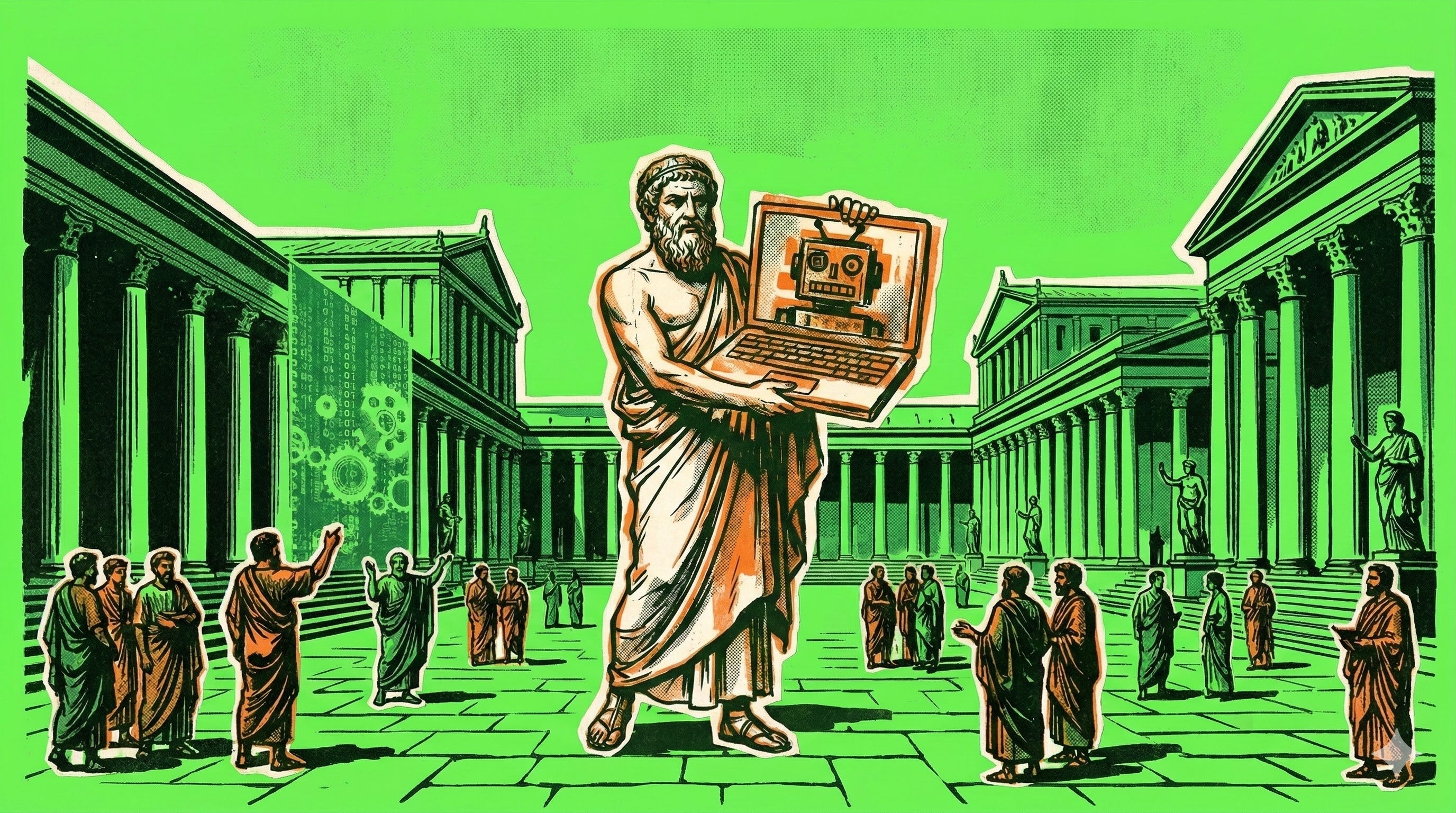
Creativity Has Often Been Outsourced
The discomfort arrived early. Speaking ideas into a document and then feeding that raw material to a language model to help shape and compose felt like a kind of evasion; inspiration on my end, execution outsourced. But the more I sat with that unease, the more I suspected it was pointing somewhere more complicated than a simple moral failing.
Consider the Renaissance studio, where a master would conceptualize a painting and leave vast portions of the execution to apprentices. The vision was the master’s; the brushwork, often, was not. The documentary Exit Through the Gift Shop modernizes this unease almost to the point of parody: Mr. Brainwash runs a factory of assistants producing work at scale, and the documentary pointedly refuses to tell you whether what emerges is art or elaborate hoax. The question of authorship, it turns out, has always been less stable than we assumed.
Musicians too. A guitarist’s wah-wah pedal inserts something mechanical into the moment of expression yet leaves something irreducibly human intact. Beat production in hip-hop goes further still, with machines doing substantial structural work. Nobody seriously argues the producer’s artistry has dissolved into the circuitry. What persists through all that mediation is worth naming carefully: the originating vision, the animating idea that existed before any tool touched it.
The Original Tech Pessimist
Which brings me back to the sophists, and to the man who found them most alarming.
Socrates was, among other things, a committed technological pessimist. The great disruptive technology of his age was writing itself, and he distrusted it profoundly. Commit thought to the page, he argued, and you produce something that looks like knowledge but cannot defend itself; it will say the same thing to everyone, cannot answer questions, cannot sense when it is speaking to the wrong audience. Writing, for Socrates, was tekne in its worst form: a simulation of wisdom that let people skip the hard interior work of actually becoming wise.
He had a point. He also delivered it exclusively through conversation, leaving nothing written down.
The Student Who Saved Him (With the Thing He Hated)
This is where the story gets delicious, and a little ironic as only the Greeks could do. We know everything Socrates thought because Plato disagreed with him. Plato took his teacher’s spoken arguments, the ones Socrates trusted precisely because they were alive, responsive, unmediated, and committed them to the permanence of text. The man who feared writing was preserved by it. Without Plato’s willingness to reach for the very technology his teacher condemned, Socrates would be a footnote, or nothing at all.
So Which Is It?
Here is the question our moment presses on us: is AI the new writing, a tool that looks dangerous but will ultimately carry human thought further than any previous technology? Or is it something closer to the sophist’s textbook—a device that generates the appearance of insight, flatters its users into believing they have said something, and quietly erodes the interior life that makes genuine thought possible?
I do not think the answer is obvious, and I am suspicious of anyone who delivers it with confidence in either direction. What I do think is that the distinction Socrates drew, however much he overcorrected, remains the right one to keep in focus: there is a difference between a tool that extends and sharpens thought, and a tool that substitutes for it. The wah-wah pedal does not feel the music for the guitarist. The printing press did not write Paradise Lost. Whether AI belongs in that lineage of honest amplification, or whether it is something the sophists would have recognized and immediately tried to monetize, depends grealy on what the person behind the prompt brings to the room.
The Cup at the End of the Argument
Socrates was not wrong about everything. His suspicion of easy knowledge, of borrowed eloquence, of wisdom retailed in convenient packages: all of it still cuts.
The tools we trust with our thinking have always carried consequences. The question is whether we are thinking clearly enough to see what they are.
The Athenians eventually decided Socrates was a problem. They handed him a cup of hemlock and called it democracy.