


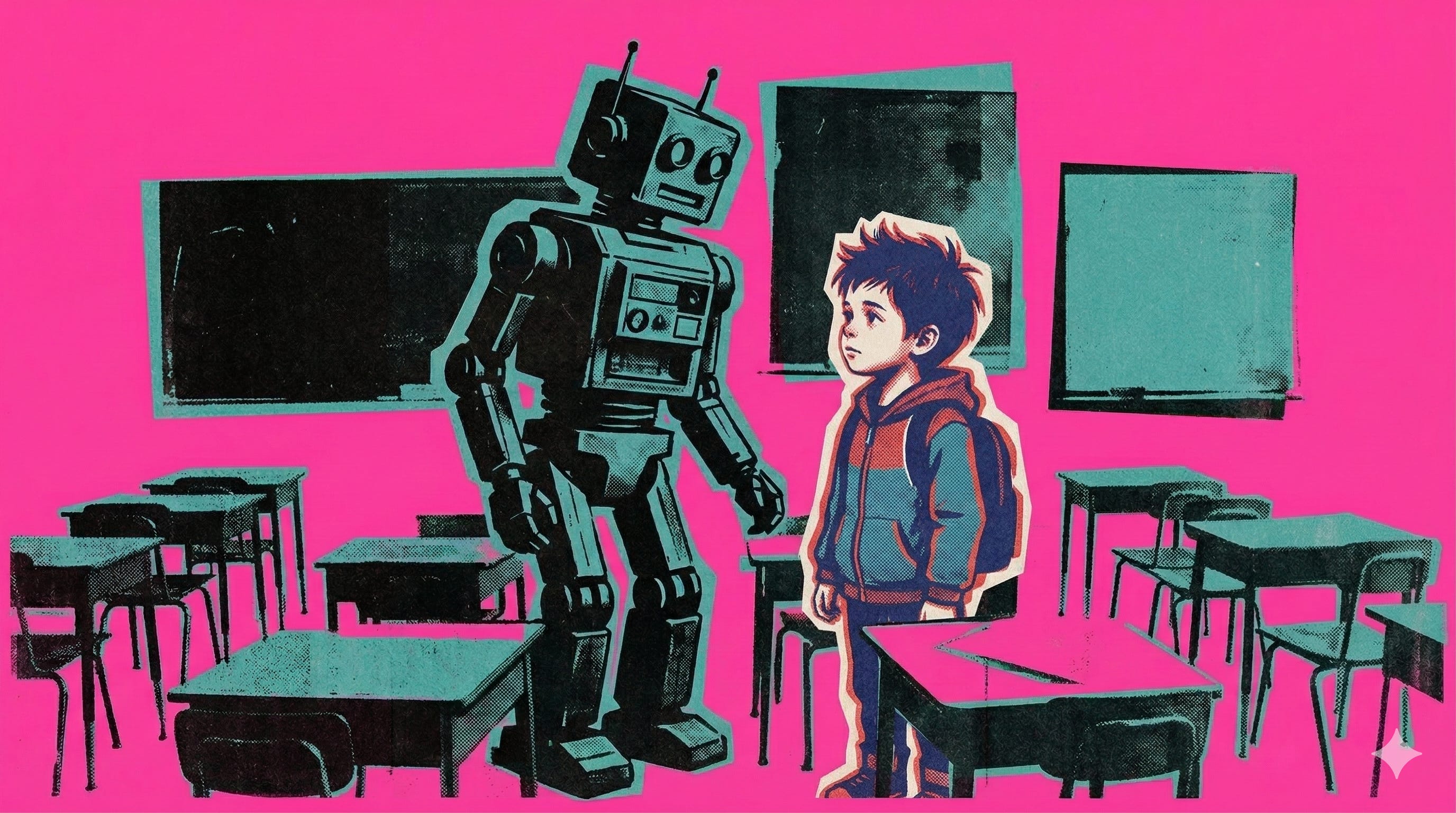
Someone asked me recently what potential I saw for AI in education. I have a lot of thoughts about this. Too many, probably. But here’s the honest version.
If you’ve studied the history of technology in American schools, you already know the script. A bright new tool arrives with breathless promises. Philanthropists write checks. Districts sign contracts. Consultants descend. Money changes hands. And then, after the fog of enthusiasm lifts, classrooms look remarkably similar to how they looked before. The overhead projector. The interactive whiteboard. The laptop cart wheeled in like a sacrament. Billions spent; precious little transformed.
AI will follow much of that same arc. It will make some people very rich. It will waste staggering amounts of public money. Vendors will peddle products built on buzzwords rather than pedagogy; school leaders, pressured to appear forward-thinking, will buy them. This is not cynicism. It is pattern recognition.
And yet. I do think AI’s stickiness will prove greater than what we’ve seen from previous technologies. Some things will take hold in ways that genuinely matter. The place where I see the most tantalizing potential is one that rarely makes headlines: large-scale assessment.
Assessment, for better or worse, has demonstrated over the last two decades that it dictates what happens in classrooms. Standards set aspirations; tests enforce them. The instruments we use to measure learning shape the learning itself. That reality frustrates me, but ignoring it helps no one. So the question becomes: can we make those instruments smarter, more humane, more reflective of what students actually know and can do?
I think AI opens a door here that has been sealed shut for a very long time. Consider oral assessment. There was an era when speaking constituted the primary mode of demonstrating knowledge. You stood before your teacher, your class, your examiner; you answered questions in real time; you presented, defended, revised your thinking aloud. Orality was foundational to how we understood a student’s mind.
That tradition faded in lockstep with the rise of large-scale testing technologies. A few years ago, my colleague Nadia Behizadeh and I wrote about this very entanglement: how the evolution of assessment instruments has been inseparable from the evolution of the technologies used to administer them. Multiple-choice items didn’t triumph because they were pedagogically superior. They triumphed because they were scannable. The Scantron machine, not learning theory, determined the dominant grammar of American assessment.
Now picture this. AI systems can process natural language with startling fluency. They can listen, transcribe, interpret. The very method I used to compose this post — speaking my thoughts aloud while a machine helped me shape them into prose — hints at a broader possibility. What if we could administer oral assessments at scale? Not as a novelty or enrichment activity, but as a legitimate, widespread mode of measuring what students understand?
I find that prospect genuinely thrilling. Speaking is a mode of communication every bit as rich and rigorous as writing; it simply requires different capacities. A student who struggles to organize thoughts on paper might articulate a devastating interpretation of a poem when given the chance to speak it. A child whose first language isn’t English might reveal conceptual understanding through dialogue that a timed written exam would never surface.
If AI can help us build large-scale assessments that are authentically multimodal — assessments that honor speaking alongside writing, that welcome visual and performative expression — then we stand to benefit more learners and more teachers than the current regime of fill-in-the-bubble tests ever could. The promise isn’t that AI will grade students for us. The promise is that AI might finally allow us to listen to them.
Will this happen cleanly or quickly? Of course not. The history I invoked at the start of this piece guarantees mess, false starts, corporate opportunism. But beneath all that noise, there is a signal worth attending to. For the first time in over a century, the technology exists to let students speak at scale and be heard. That possibility alone keeps me paying attention.