


The science of reading has commanded increasing attention over the last several years. (Thanks is owed, in part, to this viral podcast series.) At its best, this movement has renewed a valuable focus on building students’ literacy skills and taken seriously the question of how children learn to decode and comprehend text. That focus is welcome.
But the picture is more complicated than the movement’s loudest advocates tend to acknowledge. Some highly respected literacy researchers argue that the science of reading overstates its own science — that the neuroscience of how the brain processes text is a far cry from any neuroscience that might guide the actual teaching of reading in a classroom full of living, fidgeting, complicated children. Knowing how synapses fire when a person decodes a word does not automatically translate into knowing what a teacher should do on a Tuesday morning in October with twenty-eight third graders, each carrying a different history with language. The leap from brain scan to lesson plan is longer than the branding suggests.
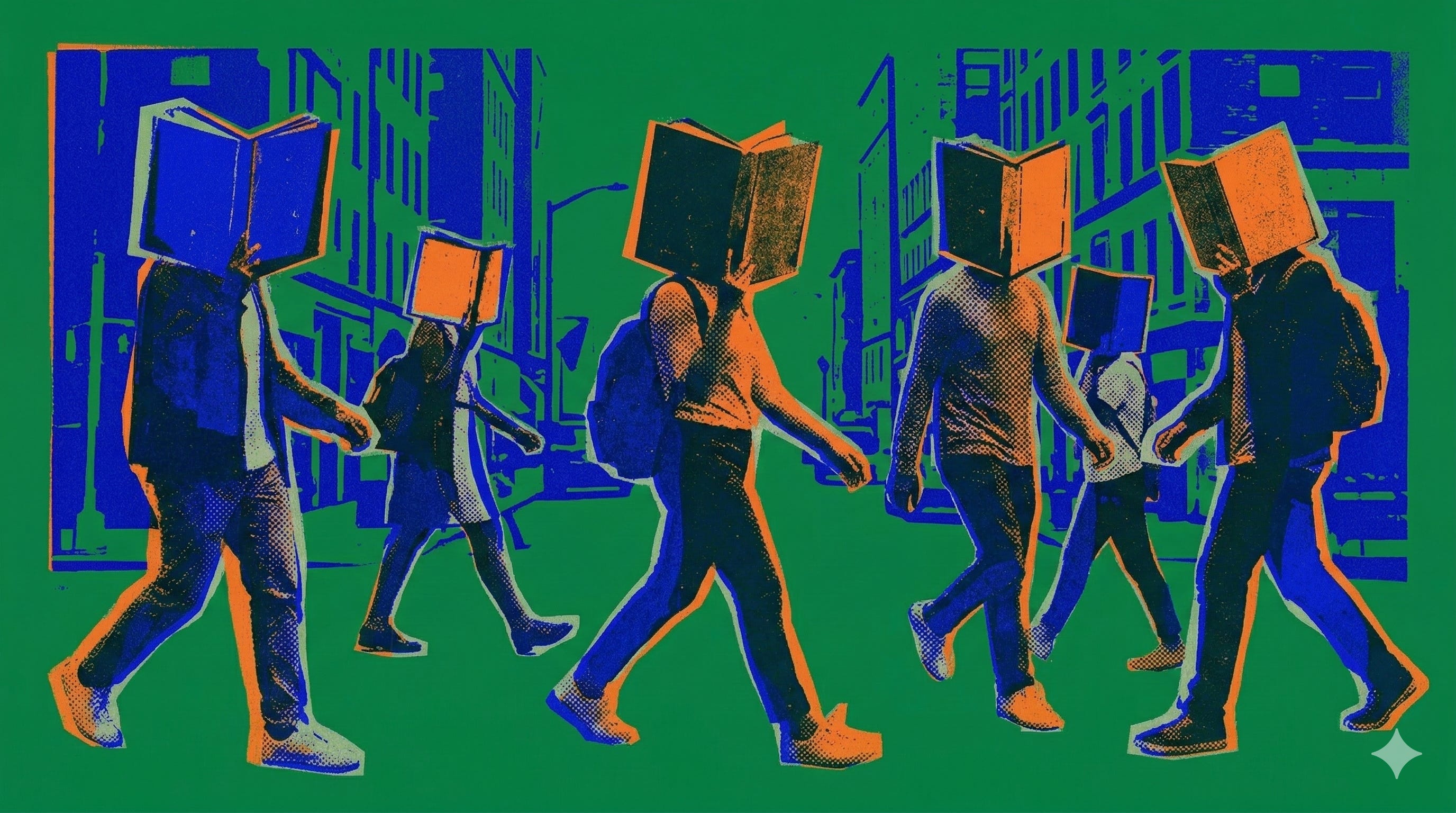
I raise that not to dismiss the movement but to insist on precision. And precision matters here because of a second, larger problem: when we allow literacy to be defined as reading, we mistake the tree for the forest.
Literacy is Bigger Than Reading
Reading is one part of what it means to be literate as a person in the world. It is not the whole of it. And yet, from a de facto perspective, that conflation is precisely what has happened in American education. I say de facto because, as I’ve argued elsewhere, tests dictate what gets taught and what gets valued in our schools. The tests overwhelmingly define literacy as reading. Reading is by far the thing that English Language Arts assessments attempt to measure. Writing, where it appears at all, receives no serious treatment — certainly not in New York State, where I’ve spent most of my career. Speaking and listening? Assessors don’t even attempt it. So literacy, in practice, collapses into reading. The other dimensions of a literate life quietly vanish from the ledger.
At first glance, that collapse might not seem terribly alarming. Reading matters enormously. But reading alone doesn’t actually make you particularly literate. It makes you someone who can read. There is a difference. If you cannot read for aesthetic pleasure; if you cannot take what you’ve read and discuss it with others, wrestle with it, challenge it; if you cannot then compose something that critiques or extends or tangles with the ideas you’ve encountered — if you cannot put something more nuanced and more yours out into the world — then one has to ask whether you meet any robust definition of literate. I am not sure you do.
Arguably, this is exactly what we’ve been doing in the United States for the last twenty-some years. In our earnest effort to take literacy seriously, we have suffocated it. We reduced it to reading alone and called the job done.
A T-Shirt that Makes the Point
Here’s an illustration that haunts me a little. If you spend enough time in schools around New York City, New York State, really anywhere in the country, you will inevitably encounter a quotation attributed to Frederick Douglass. I’ve seen it printed on posters, painted on hallway walls; I once saw it rendered as a full mural at a school entrance. The quote says, “Once you read, you will be free forever.” (I have yet to find the quote in Douglass’s writings, however.)
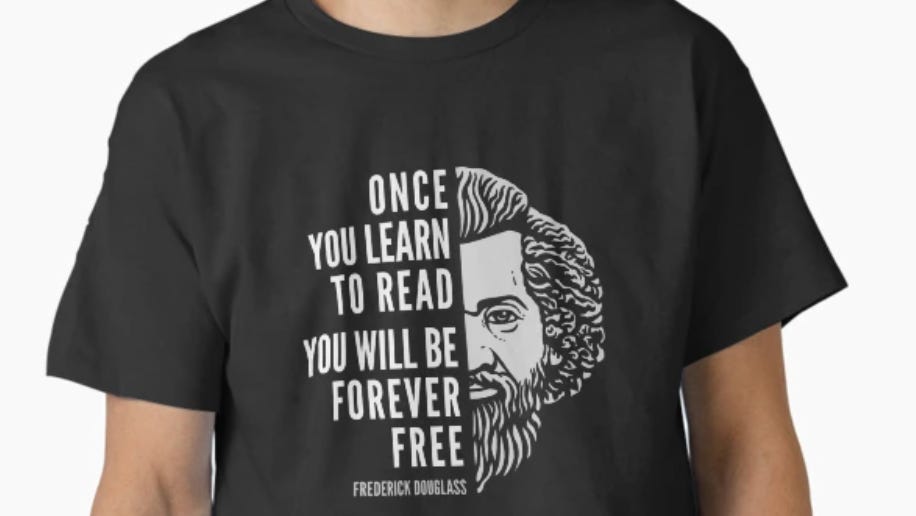
There is something deeply inspiring about that line, and the life of Frederick Douglass — what he accomplished for American education, for Black Americans, for the very idea of human dignity — cannot be overstated. His story is incandescent.
Reading is Not Enough
But there is also something incomplete about the way that quote gets applied to schools. Because it isn’t actually reading that empowered Frederick Douglass. It was his capacity to read and to write. We only know he might have uttered those words because he possessed the ability to set his thoughts down on paper with extraordinary force and precision. If Douglass could only read, we wouldn’t know how brilliant he was. We wouldn’t know him at all. His letters, his speeches, his autobiographies — these are the artifacts of a fully literate person, someone who absorbed the ideas of others and then forged something devastatingly original from them. Reading was his foundation. Writing was his freedom.
So when schools plaster that quote on their walls while simultaneously gutting writing instruction and ignoring oral expression, the irony cuts deep. They celebrate Douglass the reader while forgetting that Douglass the writer is the reason we have his work to celebrate.
Reading is necessary. It is also insufficient. It has to function as a building block, a foundation toward full literacy. And full literacy has to involve not just absorbing the ideas of others but critiquing them, discussing them, debating them — and then ultimately creating something for others that is remarkably yours and is itself worth being read. That final step, the leap from consumer to creator, is where literacy becomes power. Without it, we produce a nation of people who can decode sentences but struggle to compose one that matters.
We can do better. We owe it to Douglass, among others, to try.