


Most teachers I know carry an origin story. Somewhere in their past lives a moment of ignition; a spark thrown by a beloved fourth-grade teacher, perhaps, or a college professor who cracked open a book and cracked open a world. The stories tend to share a common architecture: a young person watches a gifted educator work, feels the gravitational pull, and thinks, That. I want to do that.
My story follows had a slightly different twist.
What’s Teaching, Anyway?
I had no designs on teaching. None. I was a philosophy and English major at Fordham, steeped in jurisprudence and narrative, aimed squarely at law school. Teaching did not occupy a single neuron of my professional imagination. The classroom, as a vocation, simply did not exist on my radar. I had spent the better part of two decades sitting in classrooms, absorbing the work of countless teachers, and yet the act of teaching itself remained invisible to me. It was like oxygen: everywhere, essential, unnoticed.
Then came the jazz.
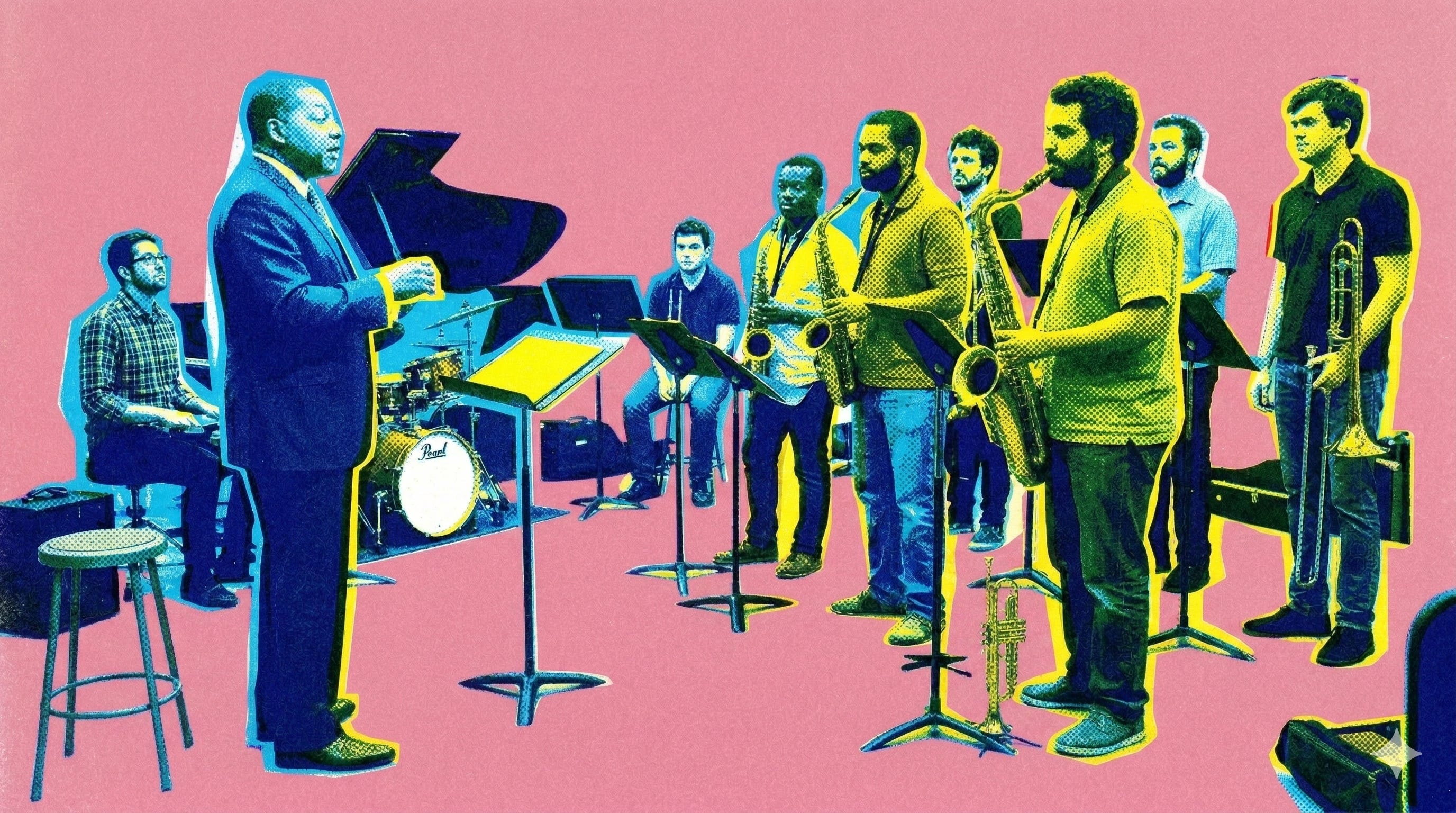
I had the improbable good fortune of landing an internship at Jazz at Lincoln Center. My duties were humble and glorious in equal measure. I attended rehearsals of the Jazz Orchestra, set up chairs and music stands, and did whatever the band needed to prepare for the next performance. I was a twenty-something kid in a room full of extraordinary musicians, setting up coffee and bagels, watching artistry unfold at close range. For someone who had always loved music (I went to music school originally, on a a singing scholarship), this was a kind of paradise.
Central to these rehearsals was the music director: Wynton Marsalis. A true virtuoso who moves between the classical and jazz worlds with a fluency that borders on the supernatural. Simply being in the same room while he conducted the orchestra filled me with a joy I struggle to articulate even now. The music poured through the rehearsal space; it climbed the walls; it settled into your bones.
A Virtuoso Teacher
One afternoon, I sat in a corner of their rehearsal studio in Hell’s Kitchen—a fairly dingy space, fluorescent lights humming overhead, nothing glamorous about it—studying for the law school admissions test. The band was preparing for an upcoming concert, and things were not going well. The orchestra wasn’t performing the way Wynton wanted. Frustration crept into the room like fog; you could feel it in the musicians’ shoulders, in the tightening of Wynton’s jaw.
And then something shifted. Rather than pushing harder, Wynton slowed everything down. He began to explain his vision for the piece, not in abstract terms but with precision and patience, working first with individual musicians, then with small groups, then pulling the full ensemble back together. He listened. He demonstrated. He coaxed and cajoled. He made the invisible architecture of the music visible.
I put down my test prep book.
For the first time in my life, it occurred to me that teaching is its own thing. Its own purposeful, intentional craft. Not a byproduct of expertise; not something that simply happens when a knowledgeable person stands in front of others. Teaching is a practice: deliberate, artful, loving. Wynton was not merely sharing what he knew about music. He was reading his audience, diagnosing what stood between them and the sound he heard in his mind, and constructing a bridge from where they were to where they needed to be. He was, in every sense of the word, teaching.
This revelation stunned me with its obviousness. How had I spent nearly two decades in schools without recognizing that what my teachers did constituted a distinct and sophisticated art? The answer, I think, is that truly skilled teaching can render itself transparent. When it works, it feels effortless, almost natural, as though understanding simply arrived on its own. The craft disappears into its own success.
That afternoon in Hell’s Kitchen, I watched the craft become visible. And once I saw it, I could not unsee it.
Questions Like Notes
I closed the test prep book for good and began exploring teacher education programs, specifically in teaching English, my second major. The rest, as they say, unfolded from there. Twenty-some years later, I find myself still inside the questions that moment opened. They resound like the notes from a trumpet: What constitutes learning? What constitutes teaching? What exactly is the relationship between learning and teaching? Isn’t all learning and teaching to some extent rooted in inspiration?
My roots in education trace back to a scuffed-up rehearsal studio, the sound of a jazz orchestra finding its footing, and one virtuoso who showed me that teaching is never incidental. It is always an act of intention, imagination, and care.
Thank you, Wynton.