


Every time a school administrator selects “Basic” from a dropdown menu, clicks a submission button, and sends a teacher’s identity hurtling into a database, something sacred happens. Not sacred in the way we usually mean. Sacred the way the word rubric originally meant it.
Here’s a detail that startled me when I first encountered it: the word rubric enters English in the 1400s from a French word meaning red. It referred to the instructions printed in red ink inside liturgical books, telling clerics exactly how to conduct church services. Rubrics, in their earliest incarnation, served as interfaces between individual human beings and authoritative institutions. They constrained variation. They preserved orthodoxy. They channeled the messy, unpredictable impulses of real people into something the institution could recognize and control.
Sound familiar?
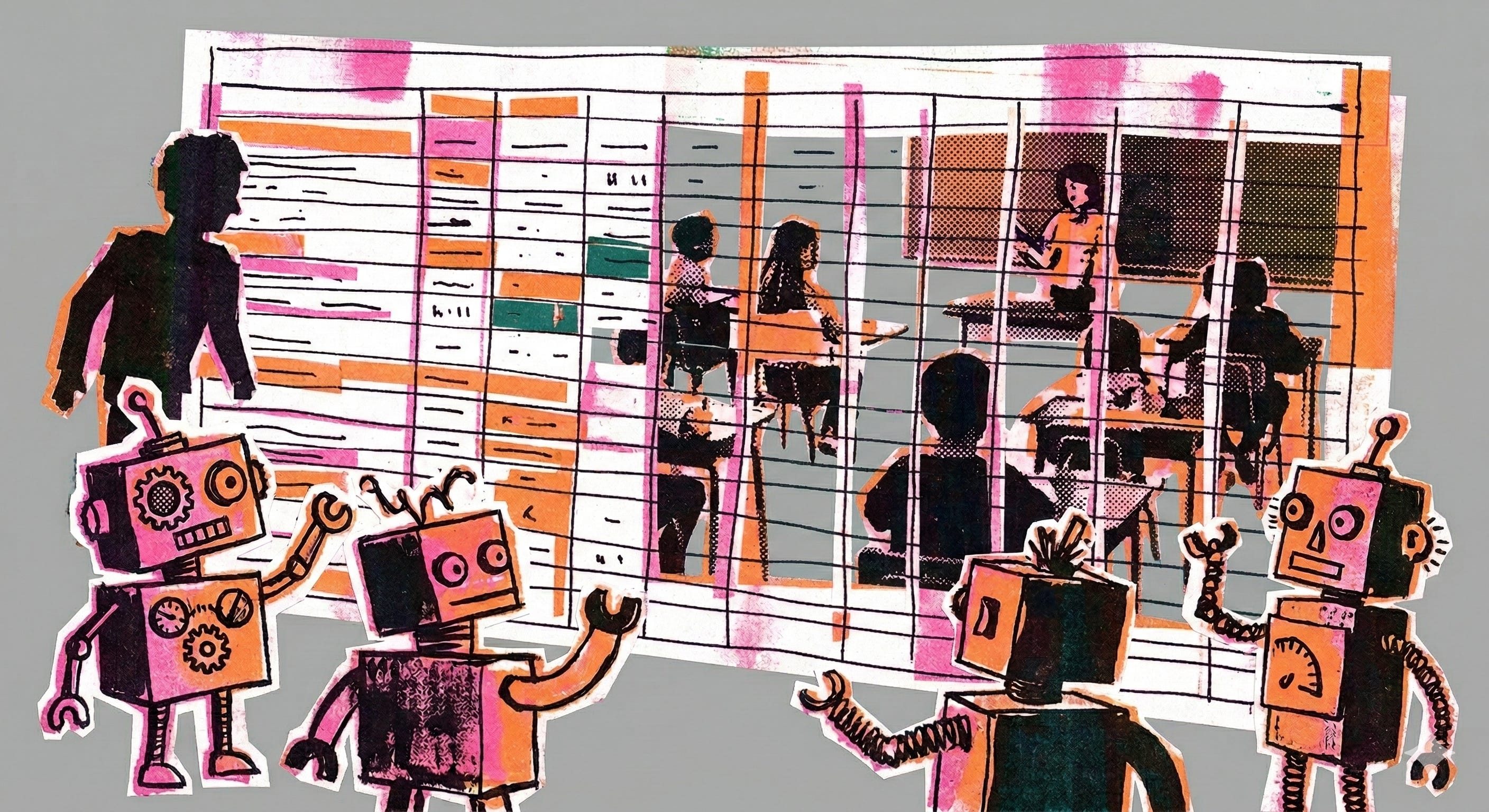
The Quiet Machinery
I spent years studying how software operates in education, and I kept circling back to rubrics. Not because they’re inherently villainous; they aren’t. A rubric can be a generous tool, a way of saying to a student or colleague, here is what we value, and here is where you stand in relation to it. That version of the rubric reflects fairness back to individuals. It lives in conversation. It breathes.
But something different happens when rubrics feed data into information systems. When that occurs, the rubric stops functioning as a social instrument and starts functioning as a computational one. It becomes, in effect, a piece of software disguised as a piece of paper.
Consider what software demands. Databases require unambiguous information filed into clearly defined categories. Algorithms need quantifiable inputs. Control statements operate in binaries: if/then, either/or. The scholar Lev Manovich calls this database logic, and he argues it seeps into culture as software becomes omnipresent. When rubrics serve as the gateway to information systems, they impose that same logic on teaching. They transcode the irreducible complexity of a classroom into neat, storable, retrievable parcels of data.
The False Choice Between “Helping” and “Deepening”
Let me show you what I mean with a concrete example. New York State’s edTPA, a teacher certification assessment born from $700 million in Race to the Top funding, includes a rubric that asks evaluators to judge whether a teaching candidate “helps students understand strategies to construct meaning from complex text” (Level 3) or “deepens student understanding of strategies to construct meaning from complex text” (Level 4).
Read those two descriptions again. Slowly.
The grid draws a hard line between them. The visual architecture of the rubric insists these are distinct, separable categories. But written language permits ambiguity, metaphor, overlap; the visual logic of the grid does not. Could a teacher help some students while deepening the understanding of others in the same lesson? Of course. That would be excellent differentiation. The rubric, however, cannot tolerate such nuance. It forces a false binary because the database waiting downstream needs a single, unambiguous number.
The evaluator must choose. Three or four. The richness of what actually happened in that classroom gets flattened into a digit that can travel through fiber-optic cables to servers belonging to Pearson Education, where it will eventually be cross-referenced with student test scores and used to evaluate the teacher preparation program that produced the candidate in the first place. A thousand-dollar fee accompanies the privilege.
There’s a Category for THAT
I watched a video once, published by a school district as a model of good evaluation practice, in which a principal and assistant principal debated whether a teacher deserved “Basic” or “Proficient.” The rubric language distinguishes between these categories using phrases about “moderate cognitive challenge” versus “significant cognitive challenge,” about lesson structures that are “recognizable” versus “clear.” Yet the administrators’ actual conversation hinged on something the rubric never mentions: whether the teacher arrived at the observation with his lesson plan already polished or needed in-the-moment coaching to sharpen a few minor details. The assistant principal had originally scored the teacher as Proficient. The principal talked him down to Basic.
That single word, Basic, then traveled from the conversation into the city’s online evaluation system, where the assistant principal selected it from a dropdown menu next to “Domain 1(e).” He clicked a button. Software sent the quantified representation of this teacher’s professional identity to a city database integrated with state systems, which packaged the data for national reporting. Algorithms applied preordained categories and canned responses. The system might eventually recommend professional development products the teacher could purchase from a for-profit vendor.
This is the pipeline. Rubric to interface to database to algorithm to marketplace. The teacher receives what a former Secretary of Education once called “feedback about their practice.” But feedback implies a conversation. What actually happens looks more like genuflection.
Software Won’t Replace Teachers; It Will Seduce Them
I want to be precise about what worries me, because I think the popular fear gets it wrong. The danger is not that machines will replace teachers. The danger is subtler, more corrosive, and already underway: as we interact with software in certain prescribed ways, we slowly defer to computational logic and the pedagogies it encourages. Teachers won’t be replaced by software. They will be seduced into thinking and teaching like it.
Rubrics accelerate that seduction whenever they serve as the transcoding mechanism between lived experience and database logic. Each time we reduce a classroom observation to a number, file it into a predetermined category, and click “submit,” we rehearse the syntax of software. We practice its grammar. We internalize its epistemology, which holds that everything worth knowing can be quantified, stored, retrieved, and algorithmically acted upon.
What Rubrics Could Be Instead
None of this means rubrics must serve these purposes. A teacher educator could use the edTPA rubric to sit down with a candidate, talk through what happened in the lesson, identify strengths and struggles, and chart a path forward. No data feed. No profit-seeking company lurking at the end of the pipeline. No public reporting. If the genuine goal were to improve individual practice, this approach would be more fitting and more effective.
The same holds for teacher evaluation. Principals who treat observation rubrics as conversation starters rather than data-entry forms honor the complexity of what teaching actually is. The trouble arises when the system demands that the conversation’s conclusion be compressed into a dropdown selection and transmitted to entities whose interests extend well beyond the classroom.
We live in an era that Manovich describes as “everyware,” where software powers our phones, our markets, our transportation, our wars. Some of these entanglements with software enrich us; some constrain us; many do both simultaneously. The question for educators is not whether to engage with software but how to engage with it without surrendering the humanistic core of what we do.
Rubrics sit at the fulcrum. They can reflect fairness back to individuals, or they can transcode human experience for the benefit of databases. They can serve as earthly interfaces, grounded in the social world of classrooms and conversations, or they can serve as holy interfaces, channeling the irreducible messiness of teaching upward into a sanctified system that treats data as divine.
The choice matters. It matters every time we pick up a rubric, every time we click a button, every time we watch the complexity of a human interaction vanish into a server rack. That schoolish sacrament of pedagogy belongs to us. We should be reluctant to let it slip through genuflecting fingers.